
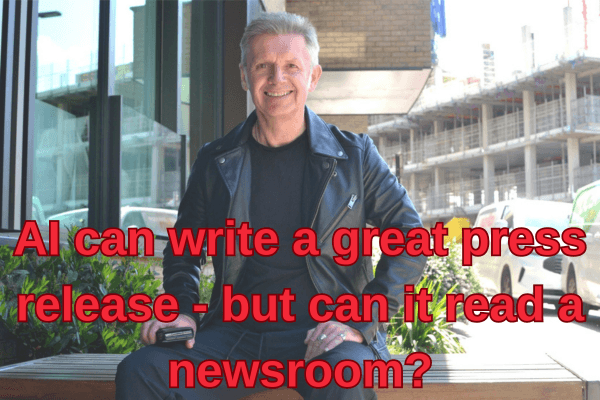
I’m increasingly being presented with press releases that clients have drafted using AI.
And why shouldn’t they?
Why pay someone to write 600 words when ChatGPT can produce something perfectly competent in ten seconds?
There’s just one problem.
If you use AI to do something you’re not an expert in, you often don’t have the expertise to spot the problems.
A press release can be beautifully written, grammatically perfect and contain every fact the client wants included – but still have virtually no chance of becoming a story.
Why? Because AI can’t read a newsroom or know the nuanced tastes of an individual journalist or media channel.
When I’m writing a release, I’m thinking about what will make a journalist stop scrolling. What the actual story is. What should be in paragraph one rather than paragraph five. What needs taking out. What their readers, listeners or viewers will care about. How much of the legwork can be done by an accompanying image or video clip.
And I’ll frequently produce different versions for different media.
A business title gets one angle. A local newspaper another. Radio needs something else again.
Sometimes I’ll change little more than the headline and opening sentence.
But after 30 years of doing this, I know those few words can be the difference between the front page and the recycle bin.
That’s the fascinating thing about AI.
The danger isn’t when it produces something terrible.
It’s when it produces something that looks perfectly good.
AI is an extraordinarily powerful tool in the hands of somebody who knows their subject. I use it myself.
But AI plus deep subject knowledge and AI without deep subject knowledge are two very different things.
So when a client jokingly suggests they’ve beaten me at my own game with their AI-generated press release, I’m not panicking just yet.
I just take a deep breath and start explaining what’s wrong with ‘their’ beautiful prose – without putting their nose out of joint.
For the moment, I’m pleased to report I still have a job.
Which is always a bonus.